



Looking for the cheapest date to travel?
Within 7 days
Outbound fromWithin 1 month
Outbound fromWithin 3 months
Outbound fromWhat customers say about Trainline
Read real reviews from real users
Travelling by train from Brussels to Bruges (Brugge)
Looking to travel from Brussels to Bruges (Brugge) by train? You've come to the right place!
You can hop on a train in Brussels and be in Bruges in around an hour, with the fastest journeys taking just 53 minutes. You'll be travelling direct on this route with SNCB. On board, you'll find comfortable seating plus space for luggage.
If you’re already visiting Brussels, why not make the most of your stay in Belgium by taking a day trip to Bruges too?
Whether you’re visiting this fairytale-like city to go to the bustling Markt (Bruges’ central square), climb the tower of Bruges’ medieval Belfry, or just indulge in beer and chocolates, taking the train is a popular option with locals and tourists alike.
Once you arrive in Bruges, it’s just a 20-minute stroll along cobbled streets lined with beautiful architecture to the city centre.
Top tip: you may also see Brussels written as Bruxelles or Brussel and Bruges written as Brugge or Brügge as Belgium has 3 official languages.
Why not start a search for cheap train tickets from Brussels to Bruges with us today?
Or if you want more information, keep reading for:
- Today’s train times
- Classes on board SNCB trains
- Services on board SNCB trains
- How to get from Brussels Airport to the city centre
- All about Brussels Midi station
- Arriving in Bruges from Brussels
- Public transport in Bruges
- Things to do in Bruges
- What to see in Belgium
- Explore Europe with an Interrail pass
- Where to travel next after Bruges
Trains to Bruges (Brugge) from Brussels
It takes an average of 58m to travel from Brussels to Bruges (Brugge) by train, over a distance of around 55 miles (88 km). There are normally 74 trains per day travelling from Brussels to Bruges (Brugge) and tickets for this journey start from £11.45 when you book in advance.
| First train | 00:40 | |
|---|---|---|
| Last train | 23:51 | |
| Departure station | Brussels | |
| Arrival station | Bruges (Brugge) | |
| Journey time | From 53m | |
| Distance | 55 miles (88 km) | |
| Frequency | 74 trains per day | |
| Changes | Direct trains available | |
| Price | From £11.45 | |
| Train and bus operators |
What do people frequently ask about the train journey from Brussels to Bruges (Brugge)?
Want to know more about your journey from Brussels to Bruges (Brugge)? We've compiled some of the most frequently asked questions by our customers to help you plan your journey.
How fast can trains travel from Brussels to Bruges (Brugge)?
Are there any direct trains from Brussels to Bruges (Brugge)?
How far is the train ride from Brussels to Bruges (Brugge)?
Who operates the trains from Brussels to Bruges (Brugge)?
Can I take a flight-free trip from Brussels to Bruges (Brugge)?
What is the best way to travel to Bruges (Brugge) from Brussels?
What time does the first train run from Brussels to Bruges (Brugge)?
How late does the train from Brussels to Bruges (Brugge) run?
How many trains go from Brussels to Bruges (Brugge) per day?
When do tickets from Brussels to Bruges (Brugge) go on sale?
Planning a round trip from Brussels to Bruges (Brugge)?
Deutsche Bahn, SNCB and ICE (Intercity Express) trains from Brussels to Bruges (Brugge)
Deutsche Bahn
SNCB
ICE (Intercity Express)
The Deutsche Bahn Group is owned by the German State and controls the majority of rail traffic in Germany as well as in many border regions of the country. Every year, Deutsche Bahn transports several million passengers and many stations in Germany are served exclusively by DB trains, including the ICE, IC and EC fleet.
More information
SNCB is the national railway company of Belgium, with services that include national (Intercity) and regional (Local) express trains. All SNCB trains come with both First Class and Second Class carriages. Belgium has one of the densest rail networks in the world. Seat reservations aren’t possible for any of the company's trains.
More information
The high-speed train of Deutsche Bahn, with a maximum speed of 205 mph (330 km/h), the ICE connects major cities and is also used for international travel to neighbouring countries such as Austria, France and Denmark. This train is equipped with air conditioning, a dining car, a children's compartment and power sockets. Passengers enjoy a free WiFi connection throughout the duration of the ICE trip.
More information
What ICE and SNCB classes are there from Brussels to Bruges (Brugge)?
Compare the different travel classes offered by ICE and SNCB when travelling from Brussels to Bruges (Brugge).
ICE
SNCB
Second Class
If you're travelling in ICE's Second Class, you'll get to enjoy free WiFi and a bistrò carriage where you can buy snacks and drinks.
- Power sockets
- Fold-down table
- Free WiFi
- Entertainment portal
- Bar/restaurant carriage
- Seat reservation
- Lounge access
- Catering at your seat
- Fast track
- Quiet area
First Class
In addition to all the amenities in Second Class, in First Class you'll get more legroom, a catering service, Fast Track in some stations and free access to DB lounges.
- Power sockets
- Fold-down table
- Free WiFi
- Entertainment portal
- Bar/restaurant carriage
- Seat reservation
- Lounge access
- Catering at your seat
- Fast track
- Quiet area
Second Class
If you're travelling in Second Class, you'll find plenty of luggage storage and power sockets as standard. You can reserve your seat only if you buy a group ticket.
- Power sockets
- Luggage storage
- More legroom
First Class
Upgrade to First Class and enjoy more legroom and comfier seats. You can reserve your seat only if you buy a group ticket.
- Power sockets
- Luggage storage
- More legroom
What are the onboard services on ICE and SNCB?
Discover more about the onboard services offered on trains from Brussels to Bruges (Brugge).
ICE
SNCB
What luggage limits are there? | You can take as much luggage as you like for free without making a reservation. Luggage items include briefcases, laptops, rucksacks, trolley bags or suitcases. You can also take pushchairs, folding bikes, scooters, skis and surfboards. Luggage should be stored under the seat or in the overhead luggage rack. Generally, the standard dimensions of luggage racks are 70 x 50 x 30 cm. Larger items of luggage such as suitcases can be stored in the large luggage racks by the doors. |
|---|---|
What food and drink is available? | When travelling with ICE, you can enjoy an extensive menu in the on-board restaurant, or you can grab a snack from the bistro carriage. If you choose the latter, you can enjoy your food and drink in the bistro or take it back to your seat. Upgrade to First Class and you will be served complimentary food and drink at your seat. DB change their menu every three months, but you will always find a wide variety of locally sourced food and drink, including a range of vegetarian and vegan dishes. |
What onboard entertainment is available? | If you’re travelling on a ICE train, you can connect to the free WiFi and catch up on some work or your favourite TV show. You can also connect to the ICE portal, where you’ll find a wide range of entertainment, such as films, television, audiobooks, games, newspapers and magazines. |
What facilities are there for travel with children? | On DB’s ICE trains, kids under 5 years old travel for free and don’t need a ticket. Children up to 14 years old travel for free if they are accompanied by a person who is at least 15 years old. You can also book family areas and children compartments on all ICE trains. |
Can I bring a bike on board? | With ICE, you need a bicycle ticket and reservation to take a bicycle onboard. The reservation for your bike is included in the price. Generally, bike storage spaces are located in second class carriages. Please note that your seat and bike storage space might be located in different carriages. |
Can I bring pets on board? | You can travel with your pet on all ICE trains. You do not need an extra ticket If you have a small dog and they can travel in a transport box. If your dog or pet is bigger than the size of a house cat, you will need an additional ticket, which costs 50% less than a standard ticket. Dogs not travelling in a transport box must be on a lead and wear a muzzle. Assistance dogs travel free of charge and do not have to wear a muzzle on the train. |
What special assistance is available? | DB’s Mobility Service can assist you with boarding, disembarking or changing trains. Also, staff are happy to answer any questions or assist with any queries to make your journey easier. |
What luggage limits are there? | When travelling with SNCB, each passenger can take 3 items of luggage on board, as long as the total weight does not exceed 30kg. Once you’ve found your seat, you can stow your luggage in the space provided above and below your seat. You can take the following luggage on board for free:
|
|---|---|
What food and drink is available? | Currently, SNCB does not offer a food and drink service. Although, you may bring food and drink with you to enjoy on the train. |
What onboard entertainment is available? | Currently, SNCB do not offer WiFi onboard their trains or at stations. |
What facilities are there for travel with children? | As long as they are travelling with a person aged 12 or above with a valid ticket, children under 12 can travel for free without a ticket. However, please note that this only applies to a maximum of 4 children per passenger with a valid ticket. If you have any additional children travelling with you, they will need a half-price Kids Ticket. |
Can I bring a bike on board? | Hoping to travel with your bike? You’ll need to add a Bike Supplement to your ticket. However, if you’re travelling with a folding bike, you don’t need to worry about paying. Bike Supplements are paid on top of your rail fare and cost €4 for a single journey. When boarding, speak to the train conductor and they will tell you if there are spaces available and where you can put your bicycle. SNCB advise you not to travel with a bike at Peak times, because bicycle spaces may not be available. |
Can I bring pets on board? | Guide and assistance dogs Travel is free for guide and assistance dogs. You won’t need to add a Pet Supplement to your ticket. Pets Pets are welcome to travel on SNCB trains if they are on a lead or in a small basket, cage or box. For animals on a lead, a Pet Supplement costs €3 for a single trip. If your pet is in a small basket, cage or box that is smaller than 30 x 55 x 30 cm, you do not need to pay for a Pet Supplement. Finally, your pet is not allowed to sit on the seats or tables. |
What special assistance is available? | Passengers with reduced mobility should directly contact SNCB to make use of their free assistance service. You can take your wheelchair on board the train for free, regardless of whether or not you use the SNCB's free assistance service. If you are blind or partially sighted, you can take the train for free in 2nd class. |
How do I find cheap train tickets from Brussels to Bruges (Brugge)?
If you’re planning a trip to Europe soon, our Trainline team of experts have put together some tips to help you find cheap tickets. Booking on the day in Europe is usually more expensive and costs can vary depending on the time of day, route or travel class.
1. Book in advance
2. Be flexible with your travel times
3. Buy a rail pass
4. Choose a slower or connecting train
5. Look out for train ticket sales and discounts
6. Take a night train
For specific information about how to get your hands on cheap tickets, check out our European train tickets hub.
Getting from Brussels Airport to the city centre
Flying into Brussels and not sure how to get from the airport to the city centre? Read on for more information on how to get to the heart of the city from Brussels Airport.
Brussels has one main airport – Brussels-Zaventem Airport – which is located around 7 miles northeast of Brussels city centre. From the airport, you can take a train or bus to reach the city centre.
Trains from Brussels Airport
If you want to get from Brussels Airport to central Brussels quickly, you should take the train!
The train from Brussels Airport to Brussels-Midi station takes around 20 minutes on the quickest SNCB services. Generally, the train from Brussels Airport to Brussels-Midi runs every 10 minutes between 05:00 am and midnight, 7 days a week. The airport train station is located directly below the terminal.
Buses from Brussels Airport
Although not the fastest option, taking the bus from the airport to the city centre is the cheapest option.
From Brussels Airport, you can take the Airport Line (Line 12) from Level 0, below the arrivals hall (Level 2). You’ll get to the European district, which is a stone's throw from the shops in the upper town, in about 30 minutes.
You can buy a ticket from an automated machine at the airport before you board the bus. A single trip from the airport to the city centre costs €7 (around £5.96) as of January 2024.
All about Brussels Midi station
How to get to Brussels-Midi station
Trains to Bruges depart from Brussels-Midi station. Not sure how to get there? We’ve got you covered.
Brussels-Midi station, also known as Gare du Midi in French and Zuidstation in Dutch, is located in the southern part of Brussels, which is why it is referred to as ‘Midi’ (meaning ‘south’ in French).
To get to Brussels-Midi station from the city centre, you can use different modes of transport:
- Train: If you’re near Brussels Central or Brussels North station, the easiest and most direct way is to take an SNCB train to Brussels-Midi. The journey is short, and trains are frequent.
- Metro: You can also take Brussels’ Metro. Lines 2 and 6 both stop at Brussels-Midi – just look for the station marked as ‘Gare du Midi/Zuidstation’.
- Tram: The tram system in Brussels is extensive, and several tram lines serve Brussels-Midi.
- Bus: If you’re looking for a cheaper option to get to Brussels-Midi station, you can take one of the many bus services that run between the city centre and the train station.
- Walking: If you're staying in the central area of Brussels and don't have too much luggage, you can also walk to Brussels-Midi. Passing some of the city’s most famous landmarks, it takes around 20 minutes to get to the station on foot from Grand Place in the city centre.
- Biking: Brussels has a bike-sharing system, so you could also rent a bike and cycle to Brussels-Midi if you're comfortable with urban cycling.
TOP TIP!
If you've travelled to Brussels by taking the Eurostar from London to Brussels, you’ll already be in the right place! Trains to Brussels from London St Pancras International terminate at Brussels-Midi.
What’s on offer at Brussels-Midi station?
As soon as you arrive at Brussels-Midi station, you can take advantage of the different facilities available:
- Shops and boutiques: Brussels-Midi has a variety of shops and boutiques to browse while waiting for your train, including a Carrefour Express supermarket.
- Restaurants and cafés: There are several places to grab food and drink at the station, including Pret A Manger and Starbucks. SNCB trains don’t offer catering, so it can be a good idea to pick something up at the station before you board.
- Bureau de change: Bureau de change services are available if you need to convert money.
- Waiting areas: There are designated waiting areas with seating for passengers, making your wait for your train more comfortable.
- Luggage storage: Luggage lockers are available if you want to store your bags while waiting for your train.
- Accessibility: The station is equipped with facilities and services to assist passengers with reduced mobility, including lifts and escalators.
Arriving in Bruges from Brussels
In under an hour, your train whisked you from Brussels to Bruges and you’ve arrived at Bruges train station. Now what?
If you need anything at the station, Bruges station has the following facilities:
- Toilets
- Luggage lockers
- Food and drink outlets
Alternatively, you can head straight to the city centre.
Bruges city centre is around a 20-minute walk from the station, or you can catch a bus which takes around 10 minutes. We recommend walking if you can, so you can take in some of the city’s atmosphere as soon as you arrive.
Public transport in Bruges
If you’re looking to explore Bruges, you might think about using public transport. We’ll explain your options.
You can get around Bruges in three ways:
On foot:
The best way to explore Bruges is on foot! The city centre is small so it’s easily walkable. It’s around a 20-minute walk from the train station to the Markt in central Bruges.
Once you’re in the city centre, take it easy and wander down some of Bruges’ oldest streets – did you know that the Historic Centre of Bruges is a UNESCO World Heritage Site?
Buses:
If you don’t fancy the walk from the train station to the city centre, it is possible to take the bus. The trip takes around 10 minutes, and buses run every 5 minutes – so you’ll be in the heart of the action in no time! As of January 2024, a single ticket costs €2.50 (around £2.13).
Bicycles:
You can also rent a bike if that’s more your thing! Whether you want to rent a bike for a whole day or just a few hours, cycling is an environmentally friendly way to explore Bruges.
Things to do in Bruges
Bruges may be a small, walkable city, but it’s still packed full of things to see and do! Check out some of our recommendations.
- Head to the market: Bruges’ Grote Markt (Market Square) is home to a number of bars and restaurants. Plus, if you head to the square on a Wednesday morning, you can do some shopping at the farmers’ market and sample some local produce!
- Visit the Belfry: For a view of Bruges’ skyline, you can climb the medieval Belfry tower and look out across the city. As it’s 83 metres tall, you can see for miles around!
- Take in some nature: If you’re yearning for some green space, head to Koningin Astridpark (Queen Astrid Park). Wander around and relax as you escape the hustle and bustle of the city’s main square.
What to see in Belgium
Whether you’re looking for a fully formed itinerary for your time in Belgium or you just want to know where you can go on a day trip from Bruges, we’ve got ideas aplenty for you.
Explore Europe by train with an Interrail Pass
After visiting Bruges, why not continue exploring Europe by train? With an Interrail Pass, you can travel across 33 European countries as much as you want on participating European train networks for a set amount of travel days.
You can use an Interrail Pass if you’re a European citizen or a non-European who is an official legal resident of a European country. If you’re not a European citizen or resident, you can use a Eurail Pass instead.
Where to travel next after Bruges
So it’s time to say goodbye to Bruges, but your European adventure doesn’t have to stop there. We’ve rounded up some of our favourite destinations – and you can get there by train!
Head from Bruges to London
If you’re looking at heading to the UK after your trip to Belgium comes to an end, why not go by train? It’s simpler than heading to the airport, and more environmentally friendly too!
You can get from Bruges to London by train in around 4 and a half hours.
First, take the train from Bruges to Brussels. This will take around an hour. Then, hop on a Eurostar train from Brussels to London and you’ll be across the channel and arrive at London St Pancras station in under 2 hours!
Check out our picks for 14 of the best things to do in London, or our suggested 3-day London itinerary for more inspiration.
Travel from Bruges to Amsterdam
If you want to discover the Netherlands, one of Belgium’s neighbouring countries, why not take the train from Bruges to Amsterdam? Whether you want to visit Amsterdam’s Royal Palace or the Rijksmuseum, there are plenty of things to do in Amsterdam.
There are generally two ways of getting to Amsterdam from Bruges.
- You can take a train to Brussels, and then change for a train to Amsterdam.
- You can take a train to Ghent, then change and travel to Antwerp. From Antwerp, take a train to Amsterdam.
These options are all clearly displayed in our Journey Planner, so you can pick the itinerary that best suits your plans.
Board a train from Bruges to Ghent
Want to see more of what Belgium has to offer? Head from Bruges to Ghent – it only takes around 20 minutes by train!
Hop on board a train at Bruges station and you’ll soon be at Gent-Sint-Pieters station, ready to explore a brand-new city.
There’s plenty to see and do in Ghent, Belgium’s third largest city, whether you fancy a stroll along the river or you’d rather brush up on your history in the Gravensteen castle.
Tips and tricks from our Trainline team
We love helping our customers find inspiration for their next train journey. Discover some travel stories written based on our employees' experiences.
The perfect day trip by train from Brussels to Bruges!

Travelling from Brussels to Bruges on an SNCB train

We travelled on a double-decker IC train operated by SNCB from Brussels Midi to Bruges, and it was a pleasant experience overall.
Brussels Midi station
Finding our way through Brussels Midi station was easy - there were clear signs leading us to our platform, and we didn’t need to go through a ticket gate or scan our e-tickets, which streamlined the boarding process.
On board the train
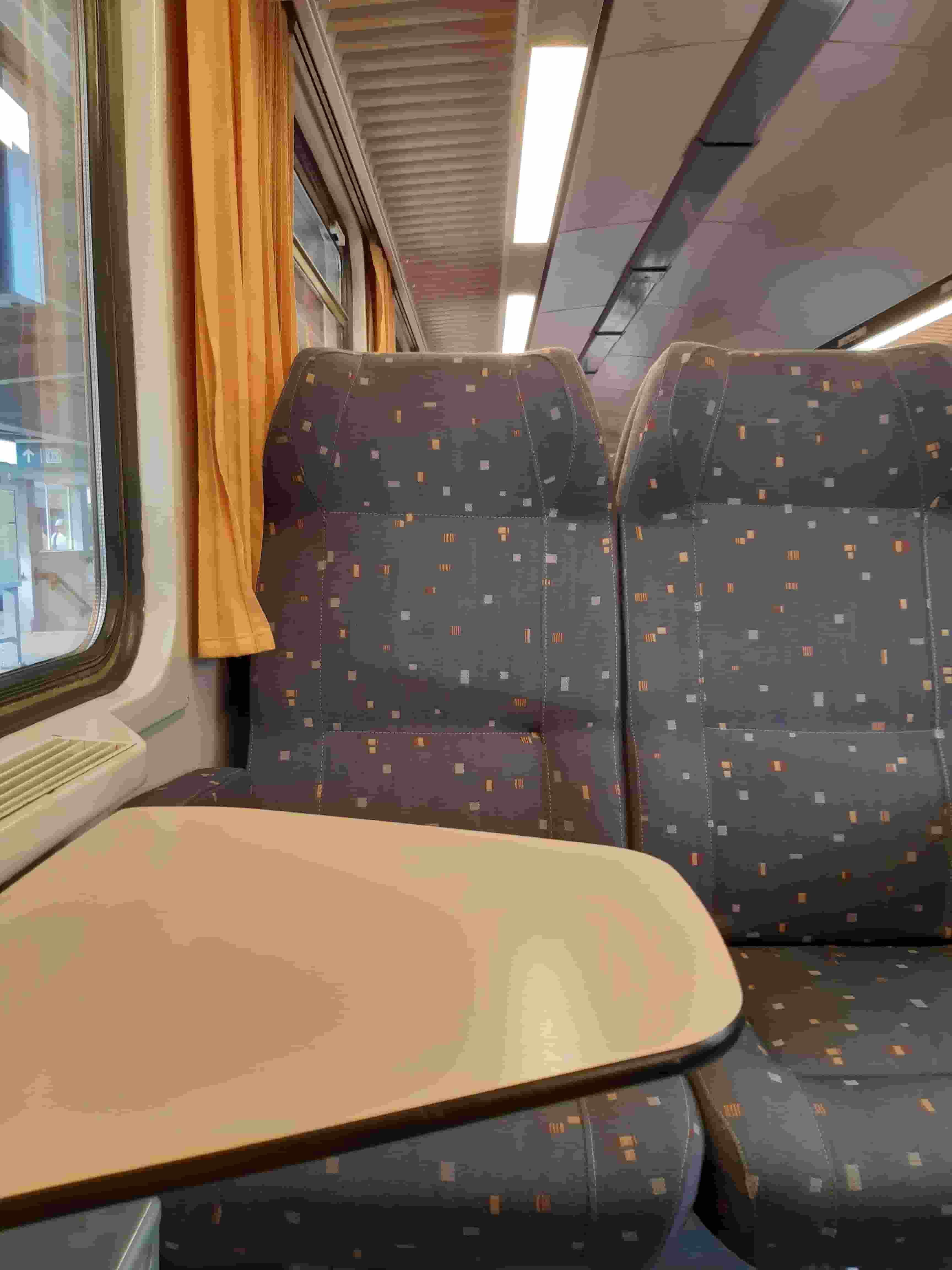
The train arrived on time, and since we were in Second Class, no seat reservations were needed. We found two empty seats in a 4-seat configuration with a small table. The Second Class seats were comfortable with plenty of legroom, and there was even a small bin under the table, which was handy. We enjoyed beautiful views of the Belgian countryside, especially the canals, which made the trip even more enjoyable.
Arrival in Bruges
The train only made one stop at Gand Saint-Pierre (Ghent) before arriving in Bruges.
The only downside was that the train didn’t have WiFi, but other than that, it was a smooth and enjoyable ride.
About Paola
Paola, a former Trainline employee, chose to share their experience of the journey between Brussels and Bruges.